Showing posts with label science. Show all posts

Tuesday, October 22, 2013

Curious romantic

curious (adj): 
1. eager to know or learn something.
2. strange; unusual.

I am a curious child. And my curiosity is curious too. I am keen about everything. This curiosity usually translates into a series of non-sequitur questions. I piece together this theoretically unrelated information into a wholesome thought and come up with bizarre insights for myself.

I am a romantic. I quote love songs reflexively to describe my relationship. However, said relationship is one that I have with my career. They say you've met your soul-mate when spending time with them is an amalgam of fun, challenge and intrigue. You continually cross paths and fate is emphasizing the inevitability of being together. So yes, BME is my soul-mate. 

There have been times, I'm so confused. 
All my roads, they lead to you. 
I just can't turn and walk away.
-All for you, Sister Hazel

My first encounter with BME was serendipitous. It was a cold January morning about a decade ago. Weeks away from turning 17, my naivete met my mother's wisdom. Few hours before my Camras interview, she convinced me to switch my major from Aerospace Engineering to Biomedical Engineering. (So much for wanting to be a neurosurgeon in space!) Thus began an epic love affair.

Sifting through hundreds of lines of code and waking up to nightmares about cortex surfaces and magnets, I sometimes wonder about my sanity and my willingness to submit to this non-being. Am I really in love with something that doesn't breathe? How could this intangible entity have a soul? 

BME takes me on incomparable adventures. We're dancing through this never ending quest. We laugh at our missteps and turn the music on louder. We whisper to each other about scientific revelations and declare our love in high impact journals. Sometimes it keeps me up all night, and I face the morning tired, but happy.

I am a curious romantic. I question my lovely soul-mate. In the process of unearthing the great mysteries of the brain, I'm sometimes teased and sometimes surprised. After weeks of mulling over a question, when the answer is finally revealed, for a few moments I'm both amazed and contented. And then a new question is formed. While I'm interested in the answers to most questions in this world, the ones that truly make me happy are the ones to questions that keep me up at night, that make me forget the lyrics to my morning-shower song, that I'm obsessed with, that I know I can solve. 

Engineers love to solve problems. It is the core of our being. Perhaps that is what pulls me back to this whimsical field. My curiosity and my romanticism are intertwined in BME. And once again, I stand at the crossroads, curious if the road less traveled will still lead me to my fate.
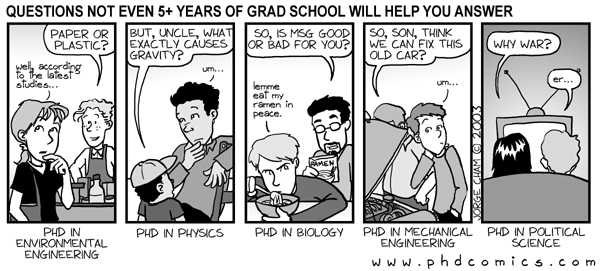

 (I accept. I'll never be able to answer any of these!)


Saturday, November 3, 2012

Crush function

Disclaimer: Because my crushes generally follow a similar trend, this is both an open letter and an apology to all the amazing crushes I have disappointed. I am sorry I stalked you through high-school only to fall for your best friend. I am sorry I made you drive to Greek town at 2am for chilli cheese fries! I am sorry I made you dance on bar tables and then ditched you for someone else. I am sorry I laughed at you when your car fell into a ditch next to my apt. I am sorry that I threw your keys into the ditch a few months later. I am sorry I stopped responding to your messages even though we had a pretty good date. I am sorry I dragged you to a horrendous local band concert. I am sorry I gave you nicknames and snickered around with my friends. I am sorry I made fun of your hair.

------------------------------------------------------------------------

Dear crush, you are a sinc function.

I use this analogy mainly because I assume you will not understand it (unless you google it). Nor will anyone else who lives a life of sanity. If you do understand though, please share that with me so my attraction towards you can increase exponentially.

You seem to alternate between realms. Not in a multiple personalities sort of way, but more like melting ice-cream. You are in two states, simultaneously. This is precisely why you emulate this extraordinary function.

The normalized sinc function (time-domain) is the fourier transform of an ideal-low pass filter (LPF) (frequency domain). Your emotional attachment is like the LPF. Only casual emotions (the friendly wave, the random bumping into each other and the small talk) are allowed to filter through. The more intense emotions (I just had a fight with my mother and I need you to hug me) are cut-off. However, the definition of our relationship is like the sinc: relatively indefinite and with ringing side-effects. The narrower you set your cut-offs with the emotions, the wider the indefinition of our relationship becomes.

I wish you could choose a side and commit to it. If you choose to adhere to the time-domain, then be vague and ambiguous about everything. At least then I can label you as a flake and move on. However, if you choose to venture over to the frequency domain, then define everything-your emotions, our interactions, or the name of the dog we will never get.

I wish I could choose a side. The truth is that I don't REALLY know you. But I know me, and I definitely am a sinc function. I linger in a sea of confusion. My emotional attention span is about 2 weeks long. I too have a LPF for emotions. It is a delta function. As a result, none of my emotions ever make it through. And most things in my life remain indefinite.

Best,
YP

Monday, October 22, 2012

Integral Infinity

Om 
Purnamadah Purnamidam
Purnat Purnamudachyate
Purnasya Purnamadaya
Purnameva Vashishyate
Om shanti shanti shanti! 

Om
That is infinite, this is infinite
From that infinite, this infinite comes.
From that infinite, this infinite removed or added,
Infinite remains infinite.
Om. Peace peace peace!

I start with this verse from Isha Upanishad, because it reads like a mathematical proof. When adding or subtracting from infinity, infinity remains infinite. I can't recall the first time I learned about the concept of infinity, but I can imagine how difficult it must have been to grasp its abstractness in context of something as defined as mathematics. In theory, if you add up every number from -∞ to +∞, you get 0. This is an unbounded sum, one which has an indefinite beginning and an indefinite end. And yet, its solution amounts to nothing. 

However, if you take this concept from the realm of mathematics and into that of philosophy, the equation changes. As is described in the verse above, the beginning and the end of time are on this spectrum between -∞ and +∞. Yet, this unbounded philosophical sum encompasses not just the existence of humanity, but that of our entire universe. It truly is, "through infinity and beyond!" And if you assume mathematics and philosophy to be on a continuum, then our universe should also amount to nothing.
 
So is it? Is the infinite breadth of our existence not even a mere speck? Or is this a more relative theory? Perhaps when compared with the truly infinite, as in God or Science or some other supreme force of nature, our being is truly miniscule. If this is true, then maybe it shouldn't matter what my legacy is. And assuming that my essence means something, is just a fancy way of expressing my vanity. 

On the flip side of infinite sum is infinite precision. Like the digits in pi. It is both irrational and necessary. Everything in this infinite universe may sum to nothing, but the details of this world are infinitely defined. This is why all constants are approximations. It is impossible to fathom these values, yet so easy to experience them. All of sudden, my existence which amounts to nothing in the infinite sum, is still infinitely defined. The forces that act upon me and the energy I release into this world is precisely defined. At a given moment, something happens because it was infinitely planned. The parameters of this infinite definition and this infinite precision are also infinite. 


I use this symbol of infinity to validate my existence every day. Sometimes, I stare at my infinity sign and use it to zap people's brains. Other times, I stare at it and wonder if this infinity sign can truly transform lives. But most of the time, it only serves as a reminder of the infinite knowledge I have yet to learn. And while this is overwhelming, for that moment I find a purpose for my miniscule self in the vastness of infinity.


Occasionally I also use infinity to define my indolence. My laziness is like the number 8. If it lays down, it becomes infinite!

Sunday, July 8, 2012

Thought Pangaea

In order to reboot the economy, we need to learn from the game of Monopoly. Everyone starts with the same amount of money and as the game goes on, people can use their wit and luck to progress.

You might think this thought crossed my mind while reading a finance article or a book on Economics (or while playing Monopoly). However, this thought really entered my unusual brain while I was analyzing the power in the beta-band of my subject's EEG data. Let me you walk through my intricate and strange thought process.

1. EEG Analysis
2. Thinking about a conversation that distracted me during lunch
3. History of how China got its name
4. How these distractions can postpone my graduation (Thanks Yan!)
5. If the recession persists, will I have to move to China?
6. What is the solution to this problem?
8. Monopoly!

This bizarre process, which only took about 100msec, led me to another question. What is the significance of of our brain's digression? Wouldn't we be more efficient if we could compartmentalize our thoughts? Our productivity would increase; our emotions would be less obstructive and overall, we would be much happier. Then why are we evolutionary programmed to think within this mess?

Despite of what the textbooks illustrate, there are no defined boundaries for brain regions. Every brain is unique. In addition, the brain is an organ of both complex anatomy and even more labyrinthine function. Each crevice has its individual purpose and yet it blends in with the whole. Unlike computers, we cannot choose which programs to shut down and which ones to run. They are all running simultaneously without regard to the RAM available. Even past events are saved comprehensively. A distinct smell or an unusual color are capable of provoking the most profound memories.

While this enables us to appreciate the potential of the human brain, isn't it in some ways throwing us off-course? Do I really need to think about summers in India and consequently, sweet mangoes, whenever it rains? Must I let my mind wander among the memories of an old friend at the whiff of AXE? Is there a purpose to thinking about Monopoly while analyzing EEG data?

I view this phenomenon as a Pangaea of thoughts: one in which there are no boundaries to where your mind can wander.  Once upon a time, our world also used to be boundary-free. I am not going to dwell on the influence of plate tectonics on the development of culture and society. However, I will comment on the significance of digression.

"Perhaps imagination is only intelligence having fun." Scialabba is right. If Steve jobs did not let his imagination take over, we would not have the treasure that is Pixar. If Salinger had not digressed, my favorite book wouldn't have been The Catcher in the Rye. Chocolate chip cookies are a result of Wakefield's creative cooking. And the implantable cardiac pacemaker is a product of a wrong sized resistor that was inserted in a recording device by Greatbatch. To his surprise, the circuit began pulsing, just like the human heart.

Our brain's ability to digress is a symbol of freedom and a sign of potential. So, the next time I space out in lab, I will consider it a blessing. Who knows, while indulged in signal processing, I could come up with a way to achieve world peace!


Saturday, April 21, 2012

Apoptotic blues

"It is a storm indeed,
but a storm of murk." - William Styron

My adviser sent me an article (http://nyti.ms/HK1jIQ) about an hour ago. It outlined the history of a field that I am very intimately involved in: depression. While I leave the scientific questions that were triggered, for the development of my dissertation, I will paint a picture here of the cascade of emotions and a train of philosophical questions(that are also structured in a scientific manner) that were provoked.

The basis of the article was that much of the brain is still a mystery. Although great minds are slowly uncovering the layers, we are finding underneath them a plethora of messy details that need to be sorted. Amidst this disarray, lies the phenomenon of depression. What struck me most about this article, was the connection between neuronal growth and the maintenance of a "happy" state. It implied that emotional well-being was buried in the connections between different brain regions.

So then it makes sense why some of your memories are permanent while others still are transient. To relive a memory means to strengthen the connections associated with it. If that memory is associated with an emotional high, you assume a joyful state. However, if that memory is associated with an emotional low, you descend into a sad or depressive state. This led to several questions.

What is the statistical mode of my memories? In other words, which of my memories do I re-live the most? If I assume my theory about strengthening connections is true, then an old childhood memory probably has been relived the most because it had the most chances to be retrieved. Maybe it is the time when I won my first dance competition at age 3. Or maybe the day I dressed up as a frog for my ice-skating show. Or perhaps the time when I got stabbed in the back with a pencil by my sister. Or it must be the incident from National Park in Dubai when I spelled "red" incorrectly. Yes, it must be the last one since I now spell my colors correctly.

In contrast, I could have only re-lived an event that happened yesterday a couple times because of the limits of time. However, is it not true that our recent past is more indicative of our current state than something from decades ago? I instantly feel a sense of pride and nostalgia when someone mentions Cornell or IIT. I can't help but blush when a song comes on and the lyrics include the name of my latest crush. And I am still experiencing a happy high from the chocolate binging I indulged in last night. Perhaps the element of temporal distance (how far is t-event from t-present) should be included with the weight of frequency.

However, this model fails to include another aspect of current state. The brain lives in 3 tenses: the past, the present AND the future. In order to accurately predict the present state, one must also account for future events. Our minds are constantly preparing for the future whether that future is a few hours away (thinking about your next meal) or a few days away (thinking about your upcoming deadline). Sometimes we look forward to these events and on other occasions we just want to get through them. Our attitude towards this future event further determines our current state. I can attest to this personally, because every year, I am in a constant state of joy from Dec 24- Feb 24th and on Jan 24th, my birthday, I experience an exceptional high. For this reason, I will re-label temporal distance and call it a temporal radius to add the effect of future.

For now these parameters will suffice in helping me determine my current state. In a mathematical sense:

C-present = sum(C-past) + sum(C-future)
C(memory) = {frequency*(-1)^n}/t-radius
---- n = 0 for positive memories and 1 for negative memories
---- t-radius = absolute value (t-event - t-present)

However, this leads me into a infinite sum since I have infinite memories. This is because the reality of my brain which includes my thoughts, imaginations, dreams and experiences is much more complex than the reality of my life which only includes facts. So I return to my initial observation: emotional state is an enigma. And to make a conclusion about your current state, all you can do, is ask yourself. How do I feel right now?

I feel like I am crawling through a nebulous tunnel in a dense jungle with no cracks for a ray of sunshine. And to this my old friend Mary said, "Burn a match!"


:)

Sunday, April 1, 2012

Reciprocity Theorem

In electromagnetism, reciprocity states that if the current densities (sources) are exchanged, their respective fields can be switched too. In terms of electrostatics, if the voltage source in one branch of the circuit produces a current in the other, the same current will be produced in the first branch if the source is moved to the second. Reciprocity has applications in politics (Canadian free trade with the US) and photography as well. In simple English, source and destination are interchangeable.

This is a mighty, powerful theorem for it simplifies computation, eases understanding and supplements the modeling of many complex systems. But as usual, I wonder if this scientific concept can be translated into real life. Can we exchange sources and destinations without changing certain results?

When it comes to traveling, this is true. The distance from point a to point b is the same as the distance from point b to a. However, can we elevate this concept into something even less objective?

I just watched My sister's Keeper. I am not one to get sensitive during movies, but this one certainly captured my emotions. It's a story about a teenager, Kate, who suffers from cancer. Her younger sister, Anna, has been donating her marrow since birth. During an incredibly crucial moment, she refuses to allow her parents to make any more medical decisions on her behalf. When Kate was three, she was diagnosed with cancer. Since they could not find a marrow match for her, the parents had to conceive another child. This child was Anna. To me, this is a brilliant case of irony. There is ambiguity in who is the source and who is the destination. Is Anna the source since she has been donating her marrow to Kate her entire life? Or is Kate the source as her sickness is the very reason for Anna's existence? The truth is, no matter who the source is, the result is still that of sisterhood. Reciprocity exists.

It is difficult to justify reciprocal relationships in our subjective lives. However, we can analyze this concept for a single instant. At a particular time point and in a certain relationship, there must exist a source (someone who is giving) and a sink (someone who is receiving). At a later time point, the relationship may be reversed. One such example is that of parents and kids. Until a certain age, parents are the care-givers. However, at some point, it becomes the child's responsibility to care for the parents. I suppose reciprocity exists for romantic relationships in an oscillatory fashion.

However, today is a day to discuss the reciprocity between a prankster and his victim. If you are the prankster, make sure you devised an intelligent trick. If you are the victim, have a sense of humor and make sure you reverse your role next time ;). Either way, the result is to have fun.

Happy April Fool's Day!

ps: Add me on Draw something. It's the technological epitome of reciprocity. You can switch off between being the draw-er and the guess-er oh so frequently! ;)

Sunday, March 11, 2012

Awesomely Normal

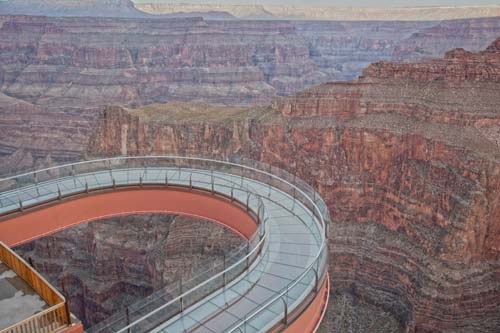
My parents just returned from a 10-day vacation to the West coast. Having forced them to take a day trip to the Grand Canyon, I was especially interested in their experience at my favorite spot. Needless to say, they loved it. However, what intrigued them most was not the marvel of nature, but that of man.


It was the skywalk at the West rim that made the most impact on them. The beauty and the elegance of this amazing experience were secondary. The core of my father's conversation was the intriguing engineering and construction of this wonder. He began with an instant glow in his eyes. The 5 hours of flight exhaustion instantly wore off. He included every intricate detail in his eloquent story and his amazement with each added fact was apparent. He compared it to the construction of the skywalk at the Sears tower (it's not Willis tower!) and admitted that the construction of the one at the Grand Canyon was both more difficult and superior.

I couldn't help but recognize the grandeur of engineers. An experience becomes doubly enjoyable when we indulge in the effort and the challenges that were involved with its being. But even so, I couldn't help but wonder why my dad found this skywalk special. He continued his story with examples of similar constructions. What made this particular one awesome for him was the fact that it was 70 feet from the edge and over 4000 feet above ground. The details associated with the creation of a frame structure and scaffolding would have demanded intense engineering and immense creativity.

However, all his examples seemed awesome to me. I thought the minar he built for a mosque in Dubai was awesome. As is my belief about the skywalk at the Sears tower. Yet he so quickly reduced those brilliant structures to the manifest of normalcy. Perhaps this is the difference between education and experience.

I find it awesome to listen to lectures about diffusion imaging. I find it awesome to learn about sensory integration. I find it awesome to discover the workings of electrical and magnetic stimulation. I find it awesome to link electromagnetic theories to the properties of the brain. But maybe, I find these awesome because my naive and immature mind is unable to discern between awesome and normal.

Often, I go into my adviser's office with a question I have been struggling with for weeks. I finally have an answer. It's brilliant. I just uncovered a milestone. So I walk in there, cheery, with big bright eyes and describe my finding. He replies with a solution far more efficient and sophisticated than the one I proposed. It takes him ten minutes to nullify what has taken me weeks. Alas, I implement it and it works like magic. Hence, my awesome has been reduced to normal.

Perhaps the journey of PhD is to attain that balance of education and experience to finally differentiate between that which is normal and that which is awesome. It is the awesome that gets published and cited and followed up. So, I may still be floating in this world of intrigue and curiosity. But it is those qualities that make for a true student and an honest researcher. If we knew all the answers and how to get them, why would we research?

I watched Proof this morning. It is a story about a mad mathematician and his devoted daughter (played by Gwyneth Paltrow). While taking care of her mentally ill father, his college drop-out daughter assists with his work in mathematics. During this period, she writes a 40-page proof that may be groundbreaking for the field. However, she hides this notebook until her father passes away. The irony is that she must now prove that she wrote the proof and not her genius father. Her only evidence is the use of modern methods that makes her proof more "hip" instead of "classic". The education of those techniques were the tools at her disposal when she didn't have experience.

The modern methods and contemporary science are our biggest weapons in advancing from normal to awesome. Sure experience is great, Dad, but it is modern education that makes it seemingly obvious that when you forget to carry your phone charger along, you don't have to freeze in the car to charge your phone. You can just unplug the USB cable and hook it up to your laptop in the warmth and comfort of your home. And while this bit may seem awesome to you, it's really just normal.

Thanks for the lesson! :)

Saturday, November 19, 2011

Just a Taste

There is a cozy little tapas bar in the Ithaca Commons, "Just a taste!". It isn't my favorite tapas place(Cafe Iberico is!), but I loved going there for one main reason: samplers! Tapas in themselves imply taste portions of incredible delicacies, but this little place also offered flights of wine in taste portions. It was an invitation to indulge in everything you desire, but in moderation. Say you got that crispy cauliflower in yogurt sauce and realized you didn't quite like it, that's okay, because the portion was just large enough to grab a taste of, but not so much so that you had to finish it even if you felt sick.

In some ways this is how I feel about boys. I think I'm excited to taste but afraid to order the whole entree. In a recent conversation with myself (because I do that sometimes to rationalize things), I had an epiphany. My longest relationship has been with Biomedical Engineering (BME). It's been seven years and going strong. And that too is because you can taste several engineerings in one bite of BME. Now, I know what most of you are thinking. Am I really going to compare real life with food? So for you, even though it's a completely valid comparison, I'll add some science to this. With the food example it may sound like this desire to taste is just a want, but with science, perhaps I can prove that it is actually a need.

Last week I was exposed to many many brilliant minds in the beautiful city of Washington, DC. Now now, hold on to your chairs, because I don't mean the politicians. I am actually talking about the great neuroscientists who unfold the mysteries of our brains. Dora Angelaki is one such scientist. She gave a talk on the importance of sensory integration. In her introduction, she explained that the significance for sensory integration lies in its ability to reduce noise and to avoid ambiguities. Her example was about the pilot who is accelerating through the clouds and is unable to tell the difference between flying upwards and plummeting downwards because his vestibular input can't separate the tilt and the translation. Without his visual feedback, the input signal is both noisy and ambiguous. By the time his head is out of the clouds (no pun intended), it's too late to correct this mistake and the plane crashes.

Perhaps my fear to commit is not irrational. Maybe when I meet my chocolate covered strawberry I'll know. Maybe all my senses with be in sync and I'll be able to make that weird promise called "love". But that time isn't now. I'm still juggling two-week crushes and quirky dates. I'm still enjoying getting hit on during Saturday night extravaganzas. I'm still loving to taste without the after taste.

Plus, I truly believe what the Blakes have sung!

Wednesday, May 18, 2011

Uncanny Valley

"Yeah, I can fly!" - Iron Man (2008)

Iron Man is one of the greatest movies of our time. Not because Robert Downey Jr. plays an attractive engineer from MIT who is nick-named "Merchant of Death", but because it brings alive a character that we fondly imagined after spending hours underneath our blankets with flashlights and Marvel comic books.

Well, these stories of fiction have caught up with reality. The exoskeleton suit that enabled Tony Stark to fight with supernatural powers has already been invented in parts across the world. In fact, research studies involving humanoid robots are heavily funded. Their applications have been identified in the fields of military, assistive devices, social replacements and to develop superpowers for ordinary people. Superpowers, you ask? It has been said that much of this research is progressing towards building unconventional suits to arm the common man with insane amount of power we witness in superhero movies.

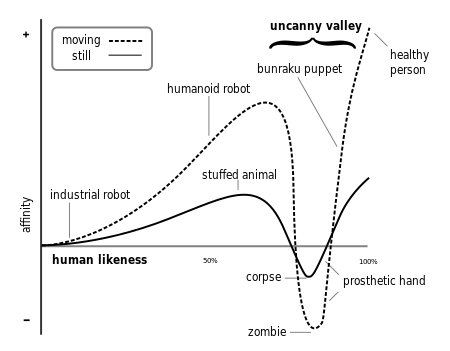
What is ironic however, is the hypothesis of the uncanny valley, first coined by Masahiro Mori. The origins of this concept can be found in the works of Ernst Jentsch and Sigmund Freud. The theory is that as a robot is made to look more like a human in appearance and function, the response from human beings will be positive. However, at a certain point this response will become that of a strong revulsion. As more advances are made on the product and the robot's characteristics become even less distinguishable from that of a man, the response once again turns positive. The valley results between "barely human" and "fully human" states of the robot.


The reasons for this valley have been attributed to mortality salience (strengthened fear of death), sorites paradox(stimuli with human and nonhuman traits undermine our sense of human), and a violation of human norms.

However, I believe that we all have experienced this valley already even without coming across these robotic engineering marvels. There are enough humans walking around this planet to instill the fear of death, undermine our sense of of human and question our belief system. Humans are threatened by other colleagues, jealous of friends, and always struggling towards that peak of power. How many times have we shut out our best friends because they can do something better than us? How many times have we abandoned people in our lives because they just don't serve a purpose anymore? How many times have we stepped on toes to climb that ladder of success? Unfortunately, I stand guilty!

These robots need to come around sooner, because with a common enemy at least our revulsion against each other might be minimized. Perhaps this futuristic concept is not too far into the future. But our encounter with the uncanny valley is definitely historic. We are not waiting to fall into this valley, because we're already buried deep. And when we fly with these super human robot systems, we can finally dig our way out!

Saturday, April 16, 2011

Eternal moment

Consider time as a complex element. Now re-consider it as a mathematically complex element (a+bi) with a real term and an imaginary term.

If you are like me, you are probably thinking, WTF?!! How can time be defined on the imaginary axis? Of all the parameters we investigate, time is the only parameter that should be both real and irreversible. However, a recent seminar (http://prezi.com/s-ezktsfry-w/wanted-nails-to-be-hit-with-numerical-ode-hammers/) I attended presented time as a particularly complex phenomenon.

Now switch modes from your objective, scientific mindset to perhaps a more subjective, artistic one. And re-evaluate the concept of time. Perhaps, think about the real component as time in which we live and imaginary term as time in which we think. It adds value to the mathematical point of view that begs one to think about time that way.

Needless to say, I wandered off on a tangent as I began thinking about how this concept falls into place in our lives. I immediately referred to my good friend, wikipedia (http://en.wikipedia.org/wiki/Time) and was amazed at the analysis of time in terms of biopsychology, time travel, big bang theory and core philosophy.

Ironically, by the time I returned to reality, the talk had reached conclusion. Time went by incredibly fast. The discrepancy between real time and imaginary time was finally apparent. I thought about the last 24 years. It seemed like they went by so fast. Then I thought about every time I had to present or perform a dance and each moment leading up to it seemed like eternity.

Even in our neuromotor control discussions, we are repeatedly faced with how we learn time-dependent tasks. Most of the studies have concluded that we in-fact don't learn in time-dependent coordinates, but instead in velocity, proprioceptive or visual coordinates. So, there is obviously an inconsistency of time in our perception, but it isn't obvious whether the real time is consistent either.

So what is consistent? What is real? This is clearly an open question and I am not sure anyone really has an answer, but we can definitely admit-- Time is a complex element!


"Time is making fools of us again." -J.K. Rowling


Saturday, March 5, 2011

Kaleidoscopic Karma

Do, or do not. There is no 'try'!

Yoda's wisdom is unmatchable. Often, we fail to notice how many times in a day we shield our incompetence with the word 'try'. This word is our tribute to the saying, "it's the thought that counts." But is that true? Is the thought enough? For that matter, is 'try' enough?

As part of our moral science lessons, we were taught, "try try again, and one day you will succeed!" However, success is not a product of trying; Rather, it is a result of doing. I believe neither the thought, nor the try, are sufficient. They are a mockery of our true potential and just hinder our progress. We deliberately choose to live in the blurry middle instead of clarifying our true intent and moving to a side. We must do something or we must not. There should not be room to say, "I tried to do it and my thoughts were in the right spirit."

I think back to high-school physics. When learning about the concept of work( Work = Fx), our teacher emphasized that in order for work to be non-zero, there MUST be displacement. So, if there is infinite force, but no displacement, no work is done. Perhaps this definition translates into real life. 'Trying' is like applying infinite force with no displacement. The end result of both is zero. Nothing lost, but nothing accomplished either.

Karma, or action is emphasized in every major philosophy. Simply put, it's the law of cause and effect. However, not all karma leads to good results. Therefore, I'm advocating kaleidoscopic karma: Action that is rapidly changing. A kaleidoscope is an instrument built with a series of mirrors that reflect a constantly changing pattern. Our actions should resemble this. They should be directed in an effect to change something. If the change isn't reflected, the course of action must be altered.

The kaleidoscopic method was also employed by Faulkner in writing A Rose for Emily. His story follows a sequential path in which one object or action triggers the next scene. It's about time I focus on my kaleidoscopic karma. One action must lead to a better action. Eventually, this cascade of actions should help me achieve my end goal. At any point if I feel that the path is leading to nowhere, it is only wise to abandon and begin on a different path. But what if it's not the path, not my actions, but the goal that seems unattainable? To this I'll quote from Star Wars again.

Luke: I can't believe it.
Yoda: That is why you fail.


So, one must do and believe. That leads to success. But isn't belief a thought? While a thought might not be sufficient, it is a precursor to action. I will explore the concept of force again. Physics describes a static condition(velocity and displacement are both zero) and a dynamic condition(motion). Thought is like the force applied in the static phase. And the static phase must precede the dynamic phase. The dynamic phase resembles action during which work is being done. So, it's not really the thought that counts. It's the action, especially one that changes your thoughts and leads to better actions.

So I will (try to) commit to kaleidoscopic karma: Indulge in actions with a cause and discard the other ones. I will (try to) believe that my goal is attainable. I will (try to) follow Yoda.

May the force be with (me and) you!

Wednesday, February 23, 2011

Pseudo Reality

"Among other things, you'll find that you're not the first person who was ever confused and frightened and even sickened by human behavior. You're by no means alone on that score, you'll be excited and stimulated to know. Many, many men have been just as troubled morally and spiritually as you are right now. Happily, some of them kept records of their troubles. You'll learn from them - if you want to. Just as someday, if you have something to offer, someone will learn something from you. It's a beautiful reciprocal arrangement. And it isn't education. It's history. It's poetry." ~J.D. Salinger, The Catcher in the Rye

Human behavior has always fascinated me, but recently, I've had the opportunity of analyzing it with a novel perspective. Being a biomedical engineer comes with its perks, and one of them is the ability to break apart every aspect of human and represent it in terms of models and equations. While this ability has advanced us greatly in the field of technology and medicine, it brings me back to a very commonly asked question. Who are we?

None of the proposed mechanisms have been able to holistically represent the human. Even when taken apart into components of mind and body, not one definition justifies the numerous theories and observations that account for what we call human behavior.

However, this is not an attempt to analyze human behavior, but instead it is an effort to take a characteristic displayed by the majority and discuss its pros and cons. As represented by the urge to converge to a solution, ironically, one distinct human characteristic is the need to categorize. This is quite obvious in both history and science. We built societies, religions, and generalized equations to group similar subjects(people, phenomena, animals, etc). One may argue that this innate need is actually to develop an organized view of the world and function more efficiently in that model.

First of all, like any model, our personal human model of the world is also not honest. It is biased, tainted, and sometimes just absurd. Secondly, categories establish differences and in order to attain efficiency, these differences need to contribute to the easier accomplishment of something. But often, these differences aren't a medium for ease. They are instead obstacles that provide for worthless basis on which to separate ourselves. They are products of fear and insecurity. This brings me to my third point, that categories don't make us efficient, but they make us comfortable. They accommodate for our vulnerability.

So maybe they do have a functional role in our evolution, but is this need to group still necessary? Or better yet, would the human race be better off without self-proclaimed differences?

I recall an incident that occurred when I was just a naive freshmen, thrown into the world of engineering. As I aimlessly struggled with the post-processing of some very noisy data, my mentor intervened. "Adjust the cutoff frequency to eliminate your garbage data, leaving you with a clean signal." I wonder if we are modulating our cutoff frequencies in order to conveniently alienate certain groups. I also speculate whether the threshold could be lowered enough to include everyone in the entire human race as one giant group. Simplify each being's existence. Alternatively, the threshold could be set so high, that the group reduces to one person and each person becomes a group. The quality of individuality is what we refer to as "unique."

So, I leave you with some questions. Should we abandon this urge to group and find a belonging within that group? Is the nature of characterization hindering human progress? While we know that the recognition of differences may be the root cause of many evil conflicts, will embracing those differences make room for peace? Or will that in turn just seed a new way for human evil to emerge? How can society value conformity, but also uniqueness? Paradoxically, how can a person who claims to be unique(a quality highly prized by the community) conform to society's expectations of being unique?

I certainly hope you all will be rather creative and individualistic in your answers and conform to my high expectations! :)

Wednesday, September 8, 2010

Schrodinger's Cat

It is no mystery that I like to draw parallels between real life and science. So here we go again with my analysis of the most paradoxical experiment with Chicago politics, my current life and much more.

Last Tuesday, I lay on my couch under my overused fleece battling fever and sore throat. But I wasn't fighting alone. On the other side of the television screen, Richard M. Daley made an announcement that instantly made me feel worse. We weren't going to witness another term of Mayor Daley!

We have experienced the Daley era in Chicago since 1955 when Richard J. Daley, the father of our current mayor took office. Now Chicago is looking at a blank slate. No heirs to take over. No legacies. No endorsements even!

But aside from the question of who to elect next, Chicago locals have other questions. Why is Mayor Daley abandoning us? Why is he retiring? Why is he not even handing over our future to another life-guard while we drown in this economic recession?

My Chicago is Schrodinger's cat. We stand at the threshold of an unknown future. We stand at the finish-line of a scandalous past. And our current state is like the cat: both alive and dead!

"He is arguably the most accomplished mayor in America today...On the presidential level, we’re always looking for a savior, but Daley shows that a prosaic workhorse sometimes turns out just as well or better," reports NY Times.

Let's shine some light on this great figure whom I have personally met several times. Mayor Daley is not the most eloquent of speakers, but he communicates to Chicagoans with spirit and hope. He united this city that was once divided on the basis of racial, economic and religious distinctions. Sure violence and crime persist, yet we attract new residents to this great city every year. We have established a cultural blend here. We have among the most severe weather conditions and yet we don't believe in hiding in our homes. We find thrills in challenges. Most people attribute the development of Chicago to the Mayor's passionate love for this city.

Speculations for his recent decision mention the deteriorating health of his wife who is a bone cancer survivor. But one is compelled to think as to what other reasons may have contributed to this unwelcome announcement. I believe that Mayor Daley loves Chicago, but he loves his esteem more. Why risk an exemplary reputation for a term that is sure to be filled with obstacles? It only makes sense to step out now with dignity. A wise philosopher once said that the key to true happiness is knowing when to stop.

Economic recession. Losing the 2016 Olympic bid. Blagojevich scandal. Budget deficits. Increasing adolescent crime. Denial to include Chicago in the 2018 Soccer Worldcup bid. I think these are reasons enough to quit gracefully. Mayor Daley wants to close the box now.

Perhaps the Rushdie influence has taken its toll on me since Midnight's Children. Much of Chicago's recent development mimics my own. My life is also Schrodinger's cat. Every outcome is possible until the box opens.

Schrodinger wrote about his experiment, "That prevents us from so naively accepting as valid a "blurred model" for representing reality. In itself, it would not embody anything unclear or contradictory."
"Most of them simply do not see what sort of risky game they are playing with reality—reality as something independent of what is experimentally established. Their interpretation is, however, refuted most elegantly by your system of radioactive atom + amplifier + charge of gunpowder + cat in a box, in which the psi-function of the system contains both the cat alive and blown to bits. Nobody really doubts that the presence or absence of the cat is something independent of the act of observation," Einstein responded, appreciating the genius of Schrodinger.

Quantum superposition actually applies to the state of an atom in the future. This is prediction. Schrodinger's experiment is questioning the state of an atom in the present. This is reality. Not just mine, but everyone's life happens between these two states. You can either know or hope to know. When what you know is unfavorable, you wish the outcome could be postponed so hope can be kept alive. When the opposite is true, you wish the outcome could be revealed because reality gives you closure.

I am not sure which state I prefer right now. My game with reality is getting intense. Here is the true paradox. The choice between knowing and hoping is mine! Until the box is closed, I can live in the blurred model or I can open this box and find out whether the cat is dead.. or alive.


As for Chicago, the box will open in February 2011! :)

Saturday, July 17, 2010

Ohm's Law

Ohm.

Not the unit of resistance in this case, but a word of liberation.

As a devout Hindu, I utter this word almost in reflex at the face of danger. This is my way of summoning God to pull me out of whatever mess I am in.

Let me clarify a few things before I continue with what is sure to spark a controversial discussion between many people. I don't call for God because I am religious. In fact religion is the exact opposite of God. Also, for those who believe that Hinduism is a religion(especially Hindus that are blinded by this misconception), you are wrong. Hinduism is a philosophy. It is a way of life. It advocates principles and morality. While belief in God is recommended, it is certainly not a requirement for faith in the Vedic philosophy. The all-knowing Wikipedia defines Hinduism as, " a diverse system of thought with beliefs spanning monotheism, polytheism, panentheism, pantheism, monism, atheism, agnosticism, gnosticism among others." So now that I have made my disclaimer, I won't be contradicting myself when I claim that I am not religious!

But many people in our society are. They are religious. They are orthodox. Or they are liberal. But religion is a definition of who they are. Perhaps the more revolutionary thinkers want to stop and think about the concept of God or an alternative superior force that governs this universe. But most people only care about rituals. About names. About diet. Some will even go further. He is Hindu, but not Brahmin. She is Christian, but not Catholic. And what does this all mean?

It means separation. It means distance. It alienates you from someone very special. So it means hate!

I immigrated to Skokie, IL in 1998. I was born in Ahmedabad, India to a set of Gujarati parents. At two months of age they brought me to Dubai, UAE, a world attraction today. But back in 1987, it was still a barren piece of land in a terrible desert where freedom of religion was just a craving. It was a place where your shelter had to be rented and your belonging was temporary. And yet we celebrated Diwali, Christmas, Eid, Hannukah, Holi and many other festivals with incomparable excitement. My parents' closest friends there were Aziz Uncle and Sakina Aunty, who made the best sevaiyya in the world during Eid. This is where I learned that the basis of friendship is not religion, but love.

So on my first day at Lincoln Jr. High School, I was taken by surprise when a white girl sitting next to me told me that I would burn in hell for not believing that Jesus Christ was the son of God. It didn't matter that I still thought he was a great guy. Or that I loved Christmas(my loyalties were towards the presents) even more than Shivratri. What mattered was that I went to a temple every Sunday and she went to a Church. What mattered was that I believed in Nahusa and she believed in Noah's ark. What mattered was that she hated me without even knowing me.

So does it make sense for religion to bring you closer to God and simultaneously distance you from man? Sure, the Bhagvad Gita advocates detachment, but not hate.

Well, the scientific Ohm's law plays a huge role in society today.

I = V/R. I is flow, V is source and R is resistance. In order to optimize flow, V must be maximum and R must minimum. If one assumes that flow refers to knowledge, source refers to origin of information and resistance refers to societal limitations, we can appropriately figure out how to maximize the flow of knowledge. A very apt example of this is the internet. The flow of information online is immeasurable because we as users(or the source of knowledge) have lots to offer and control is minimal.

So can we duplicate this? Is it so hard for us to copy the virtual world that we created for a happier society in real life? I hate the gasps that go on when a fellow aunty gossips about her friend's son who is marrying a girl from a different religion. God forbid the utter calamity that will fall upon your household if your daughter-in-law speaks a different language. Inter-religious. Inter-caste. Inter-regional. Inter-this. Inter-that. Why does a union of two souls have to focus on differences?

According to Charles Darwin's theory of survival of the fittest, two individuals mate to make a strong offspring with the best features from either parent. It is time that we blend our values to adopt stronger principles. Both, the laws of physics and theories of evolution direct us toward this. I don't think we should forsake our belief system, but diversity is a boon and it's about time we accept it.

So today's youth are facing danger from the blind-faithed, traditional older generations. It might be time to reflexively summon God again!

Ohm!

Saturday, June 26, 2010

Quantitative Romance

Matlab, to you this is an ode,
As you define the variables of my life.
Perhaps one day I can format a code,
And computation won't be a strife.

You are the heart of engineers,
The breath of mathematicians,
The ignorance of philosophers,
But truly a boon with pre-defined conditions.

With elegance you can model the hip,
Recreate the human eye,
Calculate the area of a feather tip,
Help me understand the value of pi.

I wander awestruck in your 800 line program,
With loops of if, for and do while.
Sometimes they cause a system jam,
But your uses are so versatile.

Numerical methods to approximate,
Matrices and arrays to store.
Functions to simplify and differentiate,
Integration is no longer a chore.

You may interpolate and Gaussian eliminate without any error,
But behind your tricks, I am the cognition.
So no surprise, this ode is slightly rarer,
It's not really for you, but for your magician! :)


Sunday, May 9, 2010

Domesticate Cancer?

Are you afraid of going to the jungle? Of course. There are lions, tigers, hyenas, wolves, elephants and millions of other animals that can prey on you for dinner. Are you afraid of going to the circus? No. In fact, children love the circus. Aside from the clown, there are tricks by wild animals- elephants walking on their hind legs, lions riding bicycles, monkeys displaying acrobatics and more.

Man evolved from being a hunter-gatherer to building communities. The major catalyst for this progression was the domestication of wild animals. Lions and tigers aren't practical examples, but we have domesticated useful animals like horses, bulls, goats, sheep, pigs and even carnivores like dogs. So then, it's possible to domesticate something wild and tame it so we can use it to our advantage.

Cancer. The word usually brings shivers down my spine. If it's localized, a surgeon can remove the tumor. However, when it spreads, it is like a hungry wild animal in search for prey. It attacks your body and uses your nutrients for its growth. That damn cancer cell!

But perhaps cancer research, although more complex, can benefit from the lessons of early man. Domesticate those wild things! Cancer cells have much in common with stem cells. They are undifferentiated and like stem cells they could be modified to develop according to our desires. They keep growing without restraint and that is what makes them wild. Suppression of apoptosis is key when tumor cells attack our body. And at times, we wish some of our cells didn't die or atrophy.

I am no genius. But I think there is much to learn from cancer cells and while they kill people now, they have the potential to help man make great discoveries. All man has to do, is tame them. Cancer cells aren't our enemies, but our angry pets that need some training. The answer lies in domestication. We have entered the jungles; It's time to put a leash on these cells!