Showing posts with label brain. Show all posts

Tuesday, October 22, 2013

Curious romantic

curious (adj): 
1. eager to know or learn something.
2. strange; unusual.

I am a curious child. And my curiosity is curious too. I am keen about everything. This curiosity usually translates into a series of non-sequitur questions. I piece together this theoretically unrelated information into a wholesome thought and come up with bizarre insights for myself.

I am a romantic. I quote love songs reflexively to describe my relationship. However, said relationship is one that I have with my career. They say you've met your soul-mate when spending time with them is an amalgam of fun, challenge and intrigue. You continually cross paths and fate is emphasizing the inevitability of being together. So yes, BME is my soul-mate. 

There have been times, I'm so confused. 
All my roads, they lead to you. 
I just can't turn and walk away.
-All for you, Sister Hazel

My first encounter with BME was serendipitous. It was a cold January morning about a decade ago. Weeks away from turning 17, my naivete met my mother's wisdom. Few hours before my Camras interview, she convinced me to switch my major from Aerospace Engineering to Biomedical Engineering. (So much for wanting to be a neurosurgeon in space!) Thus began an epic love affair.

Sifting through hundreds of lines of code and waking up to nightmares about cortex surfaces and magnets, I sometimes wonder about my sanity and my willingness to submit to this non-being. Am I really in love with something that doesn't breathe? How could this intangible entity have a soul? 

BME takes me on incomparable adventures. We're dancing through this never ending quest. We laugh at our missteps and turn the music on louder. We whisper to each other about scientific revelations and declare our love in high impact journals. Sometimes it keeps me up all night, and I face the morning tired, but happy.

I am a curious romantic. I question my lovely soul-mate. In the process of unearthing the great mysteries of the brain, I'm sometimes teased and sometimes surprised. After weeks of mulling over a question, when the answer is finally revealed, for a few moments I'm both amazed and contented. And then a new question is formed. While I'm interested in the answers to most questions in this world, the ones that truly make me happy are the ones to questions that keep me up at night, that make me forget the lyrics to my morning-shower song, that I'm obsessed with, that I know I can solve. 

Engineers love to solve problems. It is the core of our being. Perhaps that is what pulls me back to this whimsical field. My curiosity and my romanticism are intertwined in BME. And once again, I stand at the crossroads, curious if the road less traveled will still lead me to my fate.
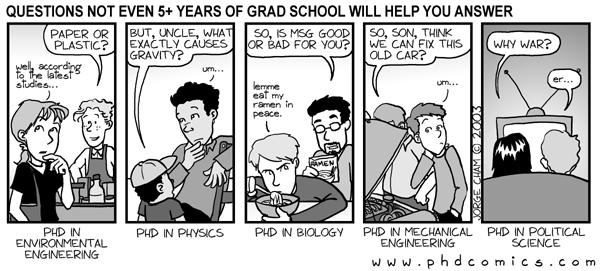

 (I accept. I'll never be able to answer any of these!)


Sunday, July 8, 2012

Thought Pangaea

In order to reboot the economy, we need to learn from the game of Monopoly. Everyone starts with the same amount of money and as the game goes on, people can use their wit and luck to progress.

You might think this thought crossed my mind while reading a finance article or a book on Economics (or while playing Monopoly). However, this thought really entered my unusual brain while I was analyzing the power in the beta-band of my subject's EEG data. Let me you walk through my intricate and strange thought process.

1. EEG Analysis
2. Thinking about a conversation that distracted me during lunch
3. History of how China got its name
4. How these distractions can postpone my graduation (Thanks Yan!)
5. If the recession persists, will I have to move to China?
6. What is the solution to this problem?
8. Monopoly!

This bizarre process, which only took about 100msec, led me to another question. What is the significance of of our brain's digression? Wouldn't we be more efficient if we could compartmentalize our thoughts? Our productivity would increase; our emotions would be less obstructive and overall, we would be much happier. Then why are we evolutionary programmed to think within this mess?

Despite of what the textbooks illustrate, there are no defined boundaries for brain regions. Every brain is unique. In addition, the brain is an organ of both complex anatomy and even more labyrinthine function. Each crevice has its individual purpose and yet it blends in with the whole. Unlike computers, we cannot choose which programs to shut down and which ones to run. They are all running simultaneously without regard to the RAM available. Even past events are saved comprehensively. A distinct smell or an unusual color are capable of provoking the most profound memories.

While this enables us to appreciate the potential of the human brain, isn't it in some ways throwing us off-course? Do I really need to think about summers in India and consequently, sweet mangoes, whenever it rains? Must I let my mind wander among the memories of an old friend at the whiff of AXE? Is there a purpose to thinking about Monopoly while analyzing EEG data?

I view this phenomenon as a Pangaea of thoughts: one in which there are no boundaries to where your mind can wander.  Once upon a time, our world also used to be boundary-free. I am not going to dwell on the influence of plate tectonics on the development of culture and society. However, I will comment on the significance of digression.

"Perhaps imagination is only intelligence having fun." Scialabba is right. If Steve jobs did not let his imagination take over, we would not have the treasure that is Pixar. If Salinger had not digressed, my favorite book wouldn't have been The Catcher in the Rye. Chocolate chip cookies are a result of Wakefield's creative cooking. And the implantable cardiac pacemaker is a product of a wrong sized resistor that was inserted in a recording device by Greatbatch. To his surprise, the circuit began pulsing, just like the human heart.

Our brain's ability to digress is a symbol of freedom and a sign of potential. So, the next time I space out in lab, I will consider it a blessing. Who knows, while indulged in signal processing, I could come up with a way to achieve world peace!


Saturday, April 21, 2012

Apoptotic blues

"It is a storm indeed,
but a storm of murk." - William Styron

My adviser sent me an article (http://nyti.ms/HK1jIQ) about an hour ago. It outlined the history of a field that I am very intimately involved in: depression. While I leave the scientific questions that were triggered, for the development of my dissertation, I will paint a picture here of the cascade of emotions and a train of philosophical questions(that are also structured in a scientific manner) that were provoked.

The basis of the article was that much of the brain is still a mystery. Although great minds are slowly uncovering the layers, we are finding underneath them a plethora of messy details that need to be sorted. Amidst this disarray, lies the phenomenon of depression. What struck me most about this article, was the connection between neuronal growth and the maintenance of a "happy" state. It implied that emotional well-being was buried in the connections between different brain regions.

So then it makes sense why some of your memories are permanent while others still are transient. To relive a memory means to strengthen the connections associated with it. If that memory is associated with an emotional high, you assume a joyful state. However, if that memory is associated with an emotional low, you descend into a sad or depressive state. This led to several questions.

What is the statistical mode of my memories? In other words, which of my memories do I re-live the most? If I assume my theory about strengthening connections is true, then an old childhood memory probably has been relived the most because it had the most chances to be retrieved. Maybe it is the time when I won my first dance competition at age 3. Or maybe the day I dressed up as a frog for my ice-skating show. Or perhaps the time when I got stabbed in the back with a pencil by my sister. Or it must be the incident from National Park in Dubai when I spelled "red" incorrectly. Yes, it must be the last one since I now spell my colors correctly.

In contrast, I could have only re-lived an event that happened yesterday a couple times because of the limits of time. However, is it not true that our recent past is more indicative of our current state than something from decades ago? I instantly feel a sense of pride and nostalgia when someone mentions Cornell or IIT. I can't help but blush when a song comes on and the lyrics include the name of my latest crush. And I am still experiencing a happy high from the chocolate binging I indulged in last night. Perhaps the element of temporal distance (how far is t-event from t-present) should be included with the weight of frequency.

However, this model fails to include another aspect of current state. The brain lives in 3 tenses: the past, the present AND the future. In order to accurately predict the present state, one must also account for future events. Our minds are constantly preparing for the future whether that future is a few hours away (thinking about your next meal) or a few days away (thinking about your upcoming deadline). Sometimes we look forward to these events and on other occasions we just want to get through them. Our attitude towards this future event further determines our current state. I can attest to this personally, because every year, I am in a constant state of joy from Dec 24- Feb 24th and on Jan 24th, my birthday, I experience an exceptional high. For this reason, I will re-label temporal distance and call it a temporal radius to add the effect of future.

For now these parameters will suffice in helping me determine my current state. In a mathematical sense:

C-present = sum(C-past) + sum(C-future)
C(memory) = {frequency*(-1)^n}/t-radius
---- n = 0 for positive memories and 1 for negative memories
---- t-radius = absolute value (t-event - t-present)

However, this leads me into a infinite sum since I have infinite memories. This is because the reality of my brain which includes my thoughts, imaginations, dreams and experiences is much more complex than the reality of my life which only includes facts. So I return to my initial observation: emotional state is an enigma. And to make a conclusion about your current state, all you can do, is ask yourself. How do I feel right now?

I feel like I am crawling through a nebulous tunnel in a dense jungle with no cracks for a ray of sunshine. And to this my old friend Mary said, "Burn a match!"


:)