Wednesday, May 18, 2011

Uncanny Valley

"Yeah, I can fly!" - Iron Man (2008)

Iron Man is one of the greatest movies of our time. Not because Robert Downey Jr. plays an attractive engineer from MIT who is nick-named "Merchant of Death", but because it brings alive a character that we fondly imagined after spending hours underneath our blankets with flashlights and Marvel comic books.

Well, these stories of fiction have caught up with reality. The exoskeleton suit that enabled Tony Stark to fight with supernatural powers has already been invented in parts across the world. In fact, research studies involving humanoid robots are heavily funded. Their applications have been identified in the fields of military, assistive devices, social replacements and to develop superpowers for ordinary people. Superpowers, you ask? It has been said that much of this research is progressing towards building unconventional suits to arm the common man with insane amount of power we witness in superhero movies.

What is ironic however, is the hypothesis of the uncanny valley, first coined by Masahiro Mori. The origins of this concept can be found in the works of Ernst Jentsch and Sigmund Freud. The theory is that as a robot is made to look more like a human in appearance and function, the response from human beings will be positive. However, at a certain point this response will become that of a strong revulsion. As more advances are made on the product and the robot's characteristics become even less distinguishable from that of a man, the response once again turns positive. The valley results between "barely human" and "fully human" states of the robot.
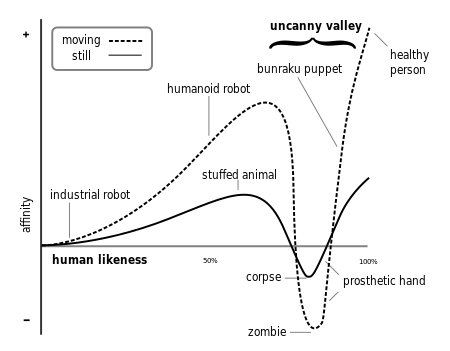

The reasons for this valley have been attributed to mortality salience (strengthened fear of death), sorites paradox(stimuli with human and nonhuman traits undermine our sense of human), and a violation of human norms.

However, I believe that we all have experienced this valley already even without coming across these robotic engineering marvels. There are enough humans walking around this planet to instill the fear of death, undermine our sense of of human and question our belief system. Humans are threatened by other colleagues, jealous of friends, and always struggling towards that peak of power. How many times have we shut out our best friends because they can do something better than us? How many times have we abandoned people in our lives because they just don't serve a purpose anymore? How many times have we stepped on toes to climb that ladder of success? Unfortunately, I stand guilty!

These robots need to come around sooner, because with a common enemy at least our revulsion against each other might be minimized. Perhaps this futuristic concept is not too far into the future. But our encounter with the uncanny valley is definitely historic. We are not waiting to fall into this valley, because we're already buried deep. And when we fly with these super human robot systems, we can finally dig our way out!


Saturday, April 16, 2011

Eternal moment

Consider time as a complex element. Now re-consider it as a mathematically complex element (a+bi) with a real term and an imaginary term.

If you are like me, you are probably thinking, WTF?!! How can time be defined on the imaginary axis? Of all the parameters we investigate, time is the only parameter that should be both real and irreversible. However, a recent seminar (http://prezi.com/s-ezktsfry-w/wanted-nails-to-be-hit-with-numerical-ode-hammers/) I attended presented time as a particularly complex phenomenon.

Now switch modes from your objective, scientific mindset to perhaps a more subjective, artistic one. And re-evaluate the concept of time. Perhaps, think about the real component as time in which we live and imaginary term as time in which we think. It adds value to the mathematical point of view that begs one to think about time that way.

Needless to say, I wandered off on a tangent as I began thinking about how this concept falls into place in our lives. I immediately referred to my good friend, wikipedia (http://en.wikipedia.org/wiki/Time) and was amazed at the analysis of time in terms of biopsychology, time travel, big bang theory and core philosophy.

Ironically, by the time I returned to reality, the talk had reached conclusion. Time went by incredibly fast. The discrepancy between real time and imaginary time was finally apparent. I thought about the last 24 years. It seemed like they went by so fast. Then I thought about every time I had to present or perform a dance and each moment leading up to it seemed like eternity.

Even in our neuromotor control discussions, we are repeatedly faced with how we learn time-dependent tasks. Most of the studies have concluded that we in-fact don't learn in time-dependent coordinates, but instead in velocity, proprioceptive or visual coordinates. So, there is obviously an inconsistency of time in our perception, but it isn't obvious whether the real time is consistent either.

So what is consistent? What is real? This is clearly an open question and I am not sure anyone really has an answer, but we can definitely admit-- Time is a complex element!


"Time is making fools of us again." -J.K. Rowling


Friday, April 8, 2011

Four eyes

Every night as I crawl under my blanket, I take off my glasses and tuck them under my pillow. My sister, my father and my grandfather all followed the same ritual. Perhaps this is an old habit that I inherited. Or it is just another one of those small things that was meant to teach me a bigger lesson.

I never gave much thought to my eye glasses or the way I treated them until they broke one night. They were kept under my pillow for convenience and in the middle of the night, I rolled over them. The next morning, I woke up blind. My glasses were shattered and my world was blurry. I had to wear contact lenses for a whole week until I got a new pair. Unlike my old Prada beauties, the new maroon pair was Chesterfield Seventh Street 4. Not only was it not designer, it was cheap, funny-looking and I hated it. Nonetheless, my dad paid for it and restored my vision.

Last night, I noticed a crack on the frame. I spent over a year making these glasses a part of me. I tuck them under my pillow every night and for some odd reason, I now love them. However, I recognized two key things with this incident. First, I was forced to recognize the innate objective of eye-glasses to provide new sight and how they symbolize clarity and perspective. Secondly, it made me realize how easily we get attached.

Gaining new perspective on situations is the most proven way to be successful. It becomes even more important when you understand how it correlates with the desire for victory. Any incident can be viewed as a win as long as you approach it with the right "perspective". I spent several years chasing a dream that was neither a part of my fate, nor an honest ambition of mine. Now, I am doing what part of this world will consider pointless, another part will deem overly-ambitious and yet another part will be ignorant of how happy it really makes me. But it really does make me happy and therefore I am a winner for finding what I love.

I hope the US government can find some perspective on the issues our nation is facing. I am sure blame is not part of gaining perspective. Nor is shutting down completely. Perhaps, it would be "perspective" to learn from other countries that are actually doing it right and implement it on our government to pull out of this mess. Maybe, it would be "perspective" to recognize the mistakes of the past not as an excuse, but as an opportunity to improve upon a system that was created hundreds of years ago and is definitely due for an upgrade. It would be "perspective" to accept that you're NOT the supreme and just this once, you can opt to focus on problems on the home-front instead of judging, meddling, and "helping" the world.

Attachment has been described as the inevitable evil. Personally, I think my attachment has transcended the basic. I may even refer to myself as a generally possessive person. I am attached to my family, my friends, Chicago, my blanket, my memories, pretty much everything. Sometimes, I can't differentiate whether my feelings towards something are a result of my attachment or my stubborn-ness. I guess this is where I'll need "perspective"!

I believe America's attachment to power has grown to an addiction. However, like me, America is stubborn and divided. Each individual is attached with a group. Each group is attached to its principles. And each principle is attached to our downfall. This is where perspective isn't just an option, but a necessity.

America needs a pair of glasses. The brand should be honesty. The objective must be to recognize their attachments and find perspective on how to undo this mess. And the result will be a clearer and happier world for all us. I hope!

"The urge to save humanity is almost always only a false-face for the urge to rule it. "

Wednesday, March 23, 2011

Reality Check

"Never before in history has innovation offered promise of so much to so many in so short a time."- Bill Gates

"If it keeps up, man will atrophy all his limbs but the push-button finger."-Frank Lloyd Wright

The good versus evil of technology debate has been going on long enough. And I am not denying that our dependence on technology is ridiculous. However, I have recently realized, we no longer use technology, but instead we live it.

Many times the facts of the real world share a blurry line with the inferences of the world wide web. Some people lead parallel lives in which their facebook profiles indicate the exact opposite of their worldly personalities. While others have a hard time differentiating what is appropriate for their online audience and what should be reserved for those who don't identify them as just an avatar.

Yes, I laugh at the thirteen-year old who absolutely must have the new social-media, mp3 wired cell phone. But I would be lying if I said new gadgets didn't excite me. However, that is not all. I recently wrote a poem about digital love and how the new generation feels more comfortable chatting online before having that first date. Blocking is now synonymous to ignoring someone and emoticons are the new weapons to subtle flirting.

Everyday I board my train assuming it will be a good way to sneak in a nap. However, for the first 15 minutes I browse facebook. Then, I read the daily news on NYTimes, TIME, CNN, BBC. Half-way into my ride I realize there's not enough time for my nap and so I catch up with my literature review articles. I get off the train, tired, sleepy and slightly more informed. I promise myself that the ride back will be more relaxing since I won't have a full day of classes and assignments to complete. Nonetheless, the evening commute follows the same schedule.

Being wired in isn't a luxury anymore. We expect instant replies. We submit to our curiosities. We are so desperate to be connected with each other in the virtual world, that sometimes we forget what the real world demands. A recent experience helped me realize the true worth of doing things the primitive way.

I recently mailed a birthday card to an old friend. On any occasion of modern communication, I would've expected an immediate thank you or acknowledgment of having received my generous greetings. But as I paid for my postage and walked out of the post-office a sense of calm came over me. Yes, there was still anticipation about when my wishes would reach him, but they were coupled with a satisfaction of sending something tangible. My heartfelt gesture would not just be one of the many casual fb wishes. It would not be an e-greeting lost amongst spam emails. It would not be a tribute to the greatness of cyber lords. Instead, it is a symbol of my thoughtfulness. It is a symbol of the time I spent to pick out and mail the card in today's super-fast lifestyle. It is a symbol of the few moments I spent actually thinking about my friend and his upcoming birthday. I don't believe there is any gift greater than that.

Every year, only few selected people have the privilege of receiving snail-mail from me. I certainly hope it means as much to them as it does to me. If not, it might be time to re-evaluate the reality of my world. It might not be worth detaching myself from the black-hole of technology. It might forever conclude, that the lifeless digital forms of communication have replaced true emotions. However, if that gesture still means something to my precious friends, it gives me hope that once in a while we'll check into reality and spend more time thinking about them and not their latest blog post or their fb status. It gives me hope that we'll see the world through our own eyes and not through flickr. It gives me hope that our innovations will be a medium for progress like Gates hoped and not a via point for a state of extreme laziness as claimed by Wright.

Finally, it gives me hope that these bursts of reality checks will keep me anchored to the real world, a world so beautiful that no digitalization can even come close to justifying its magnificence. A world that cannot be described with a million poems and pictures. A world that I don't have to log in and out of. A world that is mine, forever!

Saturday, March 5, 2011

Kaleidoscopic Karma

Do, or do not. There is no 'try'!

Yoda's wisdom is unmatchable. Often, we fail to notice how many times in a day we shield our incompetence with the word 'try'. This word is our tribute to the saying, "it's the thought that counts." But is that true? Is the thought enough? For that matter, is 'try' enough?

As part of our moral science lessons, we were taught, "try try again, and one day you will succeed!" However, success is not a product of trying; Rather, it is a result of doing. I believe neither the thought, nor the try, are sufficient. They are a mockery of our true potential and just hinder our progress. We deliberately choose to live in the blurry middle instead of clarifying our true intent and moving to a side. We must do something or we must not. There should not be room to say, "I tried to do it and my thoughts were in the right spirit."

I think back to high-school physics. When learning about the concept of work( Work = Fx), our teacher emphasized that in order for work to be non-zero, there MUST be displacement. So, if there is infinite force, but no displacement, no work is done. Perhaps this definition translates into real life. 'Trying' is like applying infinite force with no displacement. The end result of both is zero. Nothing lost, but nothing accomplished either.

Karma, or action is emphasized in every major philosophy. Simply put, it's the law of cause and effect. However, not all karma leads to good results. Therefore, I'm advocating kaleidoscopic karma: Action that is rapidly changing. A kaleidoscope is an instrument built with a series of mirrors that reflect a constantly changing pattern. Our actions should resemble this. They should be directed in an effect to change something. If the change isn't reflected, the course of action must be altered.

The kaleidoscopic method was also employed by Faulkner in writing A Rose for Emily. His story follows a sequential path in which one object or action triggers the next scene. It's about time I focus on my kaleidoscopic karma. One action must lead to a better action. Eventually, this cascade of actions should help me achieve my end goal. At any point if I feel that the path is leading to nowhere, it is only wise to abandon and begin on a different path. But what if it's not the path, not my actions, but the goal that seems unattainable? To this I'll quote from Star Wars again.

Luke: I can't believe it.
Yoda: That is why you fail.


So, one must do and believe. That leads to success. But isn't belief a thought? While a thought might not be sufficient, it is a precursor to action. I will explore the concept of force again. Physics describes a static condition(velocity and displacement are both zero) and a dynamic condition(motion). Thought is like the force applied in the static phase. And the static phase must precede the dynamic phase. The dynamic phase resembles action during which work is being done. So, it's not really the thought that counts. It's the action, especially one that changes your thoughts and leads to better actions.

So I will (try to) commit to kaleidoscopic karma: Indulge in actions with a cause and discard the other ones. I will (try to) believe that my goal is attainable. I will (try to) follow Yoda.

May the force be with (me and) you!

Wednesday, February 23, 2011

Pseudo Reality

"Among other things, you'll find that you're not the first person who was ever confused and frightened and even sickened by human behavior. You're by no means alone on that score, you'll be excited and stimulated to know. Many, many men have been just as troubled morally and spiritually as you are right now. Happily, some of them kept records of their troubles. You'll learn from them - if you want to. Just as someday, if you have something to offer, someone will learn something from you. It's a beautiful reciprocal arrangement. And it isn't education. It's history. It's poetry." ~J.D. Salinger, The Catcher in the Rye

Human behavior has always fascinated me, but recently, I've had the opportunity of analyzing it with a novel perspective. Being a biomedical engineer comes with its perks, and one of them is the ability to break apart every aspect of human and represent it in terms of models and equations. While this ability has advanced us greatly in the field of technology and medicine, it brings me back to a very commonly asked question. Who are we?

None of the proposed mechanisms have been able to holistically represent the human. Even when taken apart into components of mind and body, not one definition justifies the numerous theories and observations that account for what we call human behavior.

However, this is not an attempt to analyze human behavior, but instead it is an effort to take a characteristic displayed by the majority and discuss its pros and cons. As represented by the urge to converge to a solution, ironically, one distinct human characteristic is the need to categorize. This is quite obvious in both history and science. We built societies, religions, and generalized equations to group similar subjects(people, phenomena, animals, etc). One may argue that this innate need is actually to develop an organized view of the world and function more efficiently in that model.

First of all, like any model, our personal human model of the world is also not honest. It is biased, tainted, and sometimes just absurd. Secondly, categories establish differences and in order to attain efficiency, these differences need to contribute to the easier accomplishment of something. But often, these differences aren't a medium for ease. They are instead obstacles that provide for worthless basis on which to separate ourselves. They are products of fear and insecurity. This brings me to my third point, that categories don't make us efficient, but they make us comfortable. They accommodate for our vulnerability.

So maybe they do have a functional role in our evolution, but is this need to group still necessary? Or better yet, would the human race be better off without self-proclaimed differences?

I recall an incident that occurred when I was just a naive freshmen, thrown into the world of engineering. As I aimlessly struggled with the post-processing of some very noisy data, my mentor intervened. "Adjust the cutoff frequency to eliminate your garbage data, leaving you with a clean signal." I wonder if we are modulating our cutoff frequencies in order to conveniently alienate certain groups. I also speculate whether the threshold could be lowered enough to include everyone in the entire human race as one giant group. Simplify each being's existence. Alternatively, the threshold could be set so high, that the group reduces to one person and each person becomes a group. The quality of individuality is what we refer to as "unique."

So, I leave you with some questions. Should we abandon this urge to group and find a belonging within that group? Is the nature of characterization hindering human progress? While we know that the recognition of differences may be the root cause of many evil conflicts, will embracing those differences make room for peace? Or will that in turn just seed a new way for human evil to emerge? How can society value conformity, but also uniqueness? Paradoxically, how can a person who claims to be unique(a quality highly prized by the community) conform to society's expectations of being unique?

I certainly hope you all will be rather creative and individualistic in your answers and conform to my high expectations! :)

Monday, February 14, 2011

Glorious Game

It's been a while. The new year has begun. I am now 24. And I have lost a very dear person in the last few weeks. I will try to keep my thoughts organized, but I can't guarantee that I won't turn this into a giant rant. Because after all, that is what you are here to read anyway.

I have written about my grandfather before. However, it saddens me to refer to him in the past tense. He might not be here physically, but I am sure his principles and teachings are continuing his legacy by inspiring the lives of his wonderful children and grandchildren. He liked to engage in discussion and learn about new phenomena. He enjoyed traveling and playing the flute. But my dearest memories of him bring forth a very child-like character. He would play games with me, learn with me and also indulge in mischief. But that is what he considered life. A child's game. Not one to be taken seriously, but instead an experience to enjoy and cherish. Like any game, you win some and you lose some, but at the end of it, you wrap up the board, boil a pot of tea and just open up another game.

And so I have. I closed a few boards in my life and opened up new ones. I am making my moves carefully, but those damn dice have a mind of their own. So what do I do? I just play. Other players can join or leave as they please, but this time I'm playing to win. Here I am faced with another old problem. What about cheating? Is that okay as long as I win in the end? Ah, but in the game of life, you only live by the rules that you define. :)

So then it's okay to tweak those moves a little and make amends, say a little prayer before rolling the dice, and conveniently collaborating with another player. These forms of modulation are in fact necessary to succeed in the ever glorious game. Here I am, creating smaller games in this mega-tournament. Every task is a puzzle and every action is a move. If my calculation is correct, this time around, I've started off strong. Other players are already collaborating with me. Some just don't know it yet. My faith has found a permanent place. And perhaps my ego has enhanced this quality.

Playing these mini-games is almost an addiction now. Sometimes I play them unconsciously. On other occasions, I ponder retrospectively, analyzing every move made by me and by my opponent. I assign points, perhaps in a biased manner, because I always win. And the wins make the game even more enjoyable ( a positive feedback loop?).

As a conclusion to this ridiculous rant, I will pay some tribute to my latest game. Its key players are undeniably the most important people in my life. This game is strange, because the winner doesn't have to defeat the opponent, he just has to bring the opponent to his side. It's a tug of war. It's an intellectual debate. It's an adventure. It's the best game I've ever started!

I'll end with a very dear line from my favorite book, Catcher in the Rye, "Life is a game, boy."

ps: While I engage in my own exaggerated matches, I wish the Indian Cricket team the very best on the upcoming World-Cup! :)